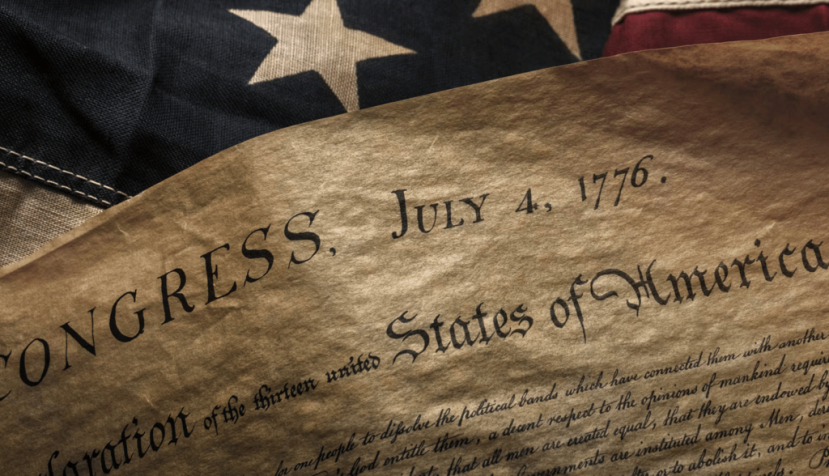
Declaration of Independence’s promises ring out today as loudly as they did for Lincoln, FDR and through 249 years of US history
The Declaration of Independence’s 250th anniversary in 2026 is certain to be a time of national reflection.
Americans tend to look to the Constitution to assess whether the nation is living up to its founding principles when navigating major social and political issues.
But it is the declaration, signed on July 4, 1776, that declares the nation’s credo, that “all men are created equal.”
Throughout history, Americans have turned to the declaration for guidance about what the nation should stand for.
As a historian of the United States and the coordinator for the University of Richmond’s Forging a New Nation initiative, which commemorates the Declaration of Independence’s 250th anniversary, I have been thinking a lot about this phenomenon.
Particularly during times of social and political upheaval, Americans have sought out the Declaration of Independence when they wanted to remedy contemporary problems and create new visions for the country’s future. Many of the nation’s greatest leaders have praised and memorialized its rhetoric and ideas in the promotion of their own.
Inalienable rights?
During the turbulent 1850s, the divisive issue of slavery permeated every facet of American life and challenged basic precepts of American freedom.
In his 1852 speech “What to the Slave is the Fourth of July?” Frederick Douglass, the formerly enslaved abolitionist, used the declaration to set a standard for American society. As a Black American, Douglass insisted he was “not included within the pale” who enjoyed the “inalienable rights” articulated in the declaration.
Nonetheless, the “great principles of the Declaration” gave Douglass hope and cause for optimism. He predicted that the “glorious hour” would soon arrive when all Americans would be defined “by equal birth.”
Conceived in liberty

In its 1857 Dred Scott v. Sanford decision, the Supreme Court denied Black Americans the rights of citizenship.
Abraham Lincoln denounced the decision and countered by defining a more capacious view of American freedom based on the declaration.
Lincoln told one audience that Thomas Jefferson and the signers of the declaration “set up a standard maxim for free society,” which they “intended to include all men” and to be “constantly looked to, constantly labored for.”
Their goal, Lincoln said, was “augmenting the happiness and value of life to all people of all colors everywhere.”
As civil war ravaged the country and claimed thousands of American lives, Lincoln again drew on the declaration to articulate a vision for the country as president.
In his 1863 Gettysburg Address, commemorating the dead on that Pennsylvania battlefield, Lincoln described the United States as a “nation, conceived in liberty, and dedicated to the proposition that all men are created equal.”
The nation, he said, was undergoing a “new birth of freedom” as it waged war on slavery and defended its government against domestic rebellion.
Self-evident truth
Seventy years later, the declaration provided inspiration for President Franklin D. Roosevelt as he steered the nation through a crippling economic depression and the run-up to a world war. Roosevelt advocated for building America’s first social safety net by drawing on the declaration.
Reflecting Roosevelt’s aims, the 1936 Democratic Party platform illustrated this rhetorical strategy, borrowing from the declaration at its very beginning: “We hold this truth to be self evident – that government in a modern civilization has certain inescapable obligations to its citizens.”
During his 1944 State of the Union Address, Roosevelt said the nation was built on the rights embedded in the Declaration of Independence and the Constitution. But, he argued, “true individual freedom cannot exist without economic security and independence.”
All created equal
Amid the political and social upheaval of the 1960s, the Rev. Martin Luther King Jr. drew directly and self-consciously on the declaration.
In his 1963 “I Have a Dream” speech, King defined an America that “guaranteed unalienable rights of life, liberty and the pursuit of happiness” to its citizens.
Though the nation had “defaulted on this promissory note insofar as its citizens of color are concerned,” King said, the declaration still offered him hope: “I have a dream that one day this nation will rise up and live out the true meaning of its creed: We hold these truths to be self evident, that all men are created equal.”
In 2025, Americans saw the deployment of U.S. troops in major cities, as well as mass immigrant deportations. These changes have upended communities and challenged basic norms of civil society. They have also challenged Americans’ understanding of themselves as a nation of immigrants.
With the declaration’s anniversary coming up at a time when so much about contemporary society and politics are being contested, Americans may well return once again to this founding document to define themselves as a people and a nation.
Graeme Mack, Visiting Assistant Professor of History, University of Richmond
This article is republished from The Conversation under a Creative Commons license.
- Publicado en Babel
- Escrito por Graeme Mack